
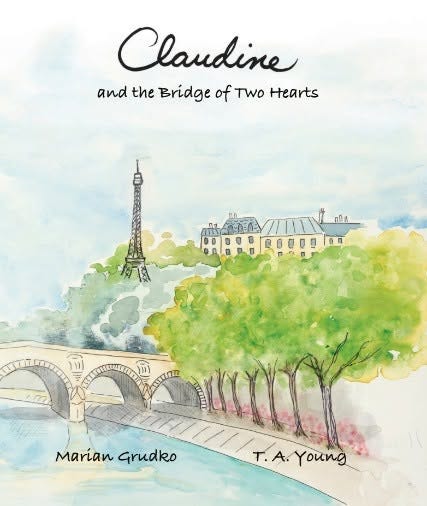
In this chapter, Claudine is in human form (yes, she can transform from ladybug to human, though she chooses later to be ladybug evermore). I chose to post this today as a special response to Antonio Castelanetta, whose Substack is titled “The Light That Remembers” (hi Antonio!)
Chapter 6: The Tree and the Otter (excerpt)
Claudine, the lady, walked the streets of Paris, not knowing where she was headed. She had almost passed that famous bookstore on the left bank, when she noticed in the window a poster declaiming the words, “Who is Claudine?” It was advertising for a mystery book by R.M. Hamilton, set in the Australian highlands. “Surely another book about me,” thought Claudine, and she turned to enter the store when the heel of her shoe caught on a cobblestone and she fell forward, thinking “Perhaps I should write a book,” and then all went dark. When she awoke, she was in a forest.
It was not a place that existed in Paris. She heard a sound like a sigh, turned again, and was face to face with Glyndynshout, the Otter.
“I’m glad you’re here,” he said. He took her hand and hurried her to a tree, whence that sigh had come.
Dee Prinkles The Oak was one-hundred and sixty-three years old. She relished life. So, what was her concern? Why were her branches hanging just a bit lower, this year? Why did her leaves, still lush, show the slightest curl at their edges? And her bark – that tells-all and hides-nothing persona - why the weariness in its role as its tree’s armor?
Dee spoke to them as if lost in thought, perhaps reminiscing: “I am here by happenstance.” Glyndynshout wanted to ask her to define “here,” but he held himself. She went on: “I was a seed once, long ago…Not so long ago if you ask the moon, or that mountain behind me. A seed caught briefly by a paw, then stuck to a talon, then packed into a boot, and finally brought to this very place by a puff of wind caused by the swing of a leopard’s tail. Here, where years don’t matter. Where years don’t exist unless you want them to. But something has brushed against my being….”
Glyndynshout looked at Claudine: He whispered to her, “What to do? What to say? Is this a real ailment?” Dee heard and said, “Real! A bit of wind from a leopard’s tail. Think about it: isn’t that precisely how we all ended up here?
Claudine said, “No…I was walking the streets of Paris and saw a book about me and then I fell…”
“How do we question how,” interrupted the tree, “when here we are?” Dee knew she had to pause to allow them to consider the million million variables that led to this precise place….as if this place were precise! The audacity of such a thought!
“And I thought I was lost!” cried the otter.
Dee said, “You had to be lost in order to be found. Claudine’s presence on that bridge…Oh, yes, I know the story…”
Glyndynshout dared to say, “We have the same story, it seems.”
Dee said, “I could have ended up anywhere.”
“Not according to your story. Considering all those things that determined your direction, you could have landed nowhere else,” said the otter. “Now that I think of it, the same with me. Maybe with all of us.”
“What if I had ended up somewhere else? asked Dee. “What if I ended up being a picnic table?”
“Then we’d be talking to a picnic table.”
Dee glowed.
(end of excerpt, Claudine and the Bridge of Two Hearts)
A great excerpt! A really good sense of telling a story inside so many dimensions. Lewis Caroll would be certainly proud of reading Claudine!
Marian, thank you for this. I smiled when I saw my name there. What stayed with me is the question underneath the whole scene: whether happenstance is really happenstance once we look backward and see all the small turns that brought us somewhere. And the picnic table line is perfect. It makes a huge idea suddenly simple, funny, and very human.